The Ghana Bar Association (GBA) has criticised Chief Justice Paul Baffoe-Bonnie over remarks comparing the performance of some state institutions under the current administration with the previous eight years, warning that such comments could create the impression of judicial alignment with the Executive.
The Chief Justice made the remarks during visits to the Social Security and National Insurance Trust (SSNIT) and the Minerals Income Investment Fund (MIIF), where he praised their current performance and questioned how the institutions had been managed over the preceding eight years.
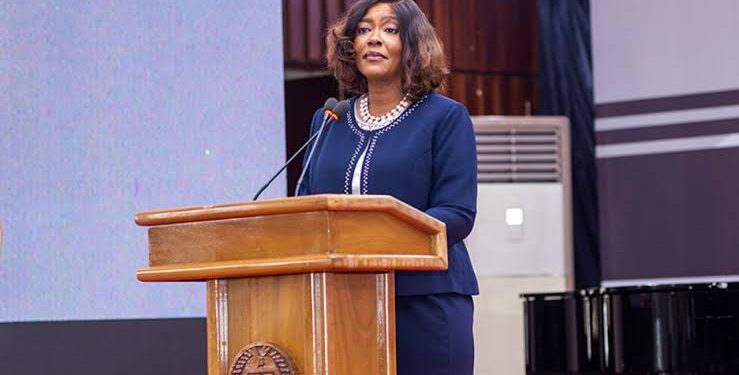
Addressing lawyers at the opening ceremony of the Ghana Bar Association Conference, GBA President Efua Ghartey described the remarks as troubling, arguing that they risk drawing the Judiciary into partisan political discourse.
“The recent commendation of a public institution and the comparison to a past government’s output by no mean a person than the Chief Justice of the Republic of Ghana left much to be desired,” she said.
Mrs Ghartey said the comments form part of a broader concern over what she described as subtle and sometimes overt communication by members of the Judiciary that suggests they are in office to promote the interests of another arm of government, particularly the Executive.
She stressed that while the Bar remains committed to protecting the independence of the Judiciary under the 1992 Constitution, judicial officers must operate within the limits of their constitutional mandate.
“The Bar wishes to set a reminder that much as it is poised to protect the independence of the judiciary, as per article 1284 of the 1992 constitution of the Republic of Ghana, the guarded must stay within their bounds as dictated by their calling in the constitution,” she said.
Mrs Ghartey further cited a Supreme Court case in which Justice Yonny Kulendi observed that holders of independent institutional and statutory offices, including judges, are constrained in their freedom or ability to actively take sides in partisan politics.
“We note that chiefs are not alone in having their free speech so restricted. Holders of independent institutional or statutory offices, notably judges, members of the Electoral Commission, the Commission on Human Rights and Administrative Justice, and the National Commission on Civic Education, are by implication from their independent status similarly constrained in their freedom or ability to actively take sides in partisan politics,” she quoted Justice Kulendi as saying.