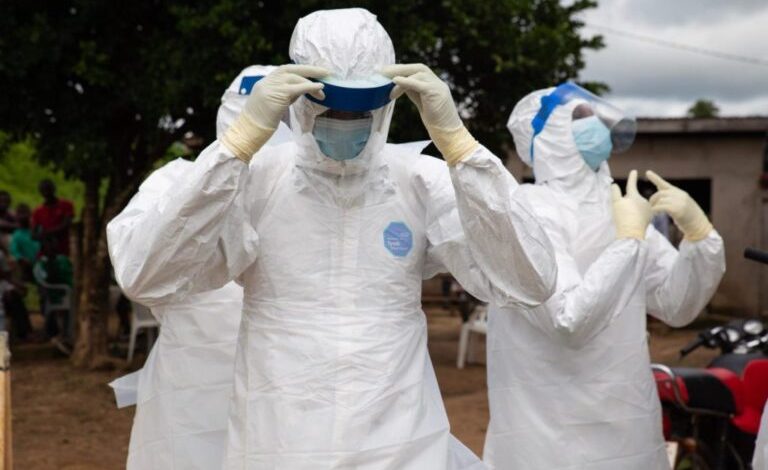
The Ghana Health Service (GHS) has activated its preparedness arrangements for Ebola and conducted about three simulation exercises to test the country’s readiness to respond to a possible outbreak.
The Director-General of the GHS, Dr Samuel Kaba Akoriyea, said the Service was monitoring developments in affected countries and coordinating with relevant institutions to assess potential risks to Ghana.
He said surveillance and emergency planning had been intensified following reports of Ebola outbreaks in parts of Africa, including the Democratic Republic of the Congo (DRC) and Uganda, alongside concerns about possible cross-border transmission.
Dr Kaba Akoriyea said Ghana remained in the preparedness phase and had begun testing its response arrangements through simulation exercises.
“So here you are, you have an outbreak in Congo, Uganda, and then you see it coming to Kenya, and we have airlines that come indirectly, day in, day out. Then from there, you see it get to Nigeria. And as I talk to you, I’m always in touch with my colleagues in those countries to know exactly what is happening,” he said.
Dr Kaba Akoriyea said the GHS was using its Public Health Emergency Operations Centre at Pantang to monitor international health developments and coordinate preparedness activities.
According to him, the centre operates around the clock to track emerging health threats and monitor developments that could have implications for Ghana.
“We’ve put it out there all the time. Every second, microsecond of the day, we scan, and we know exactly what is happening in any part of the world. It’s there,” he said.
“You can go and see. We don’t sleep, work 24 hours, and we see whatever is happening.”
The Director-General said the Service had conducted about three simulation exercises since concerns about the disease emerged in the region, adding that Ghana activated its preparedness system when the outbreak in the DRC was reported.
“When it started in DRC, we activated our system. In Congo, in Kenya, we started with simulation exercise,” he said.
The exercises are designed to test how institutions would coordinate their response to a public health emergency, including identifying and managing suspected cases, communicating across agencies and mobilising resources.
Dr Kaba Akoriyea said about 33 agencies were involved in Ghana’s preparedness efforts, reflecting a coordinated approach that extends beyond the health sector.
He said he had participated in meetings involving institutions responsible for education, security, social welfare, local government and emergency management.
Among the agencies involved are the Food and Drugs Authority, the National Disaster Management Organisation (NADMO), the National Commission for Civic Education, the Ghana Education Service, the Veterinary Services Department, the National Peace Council and the Ghana Armed Forces.
The participation of the agencies is intended to strengthen coordination in emergency response, public communication, security, logistics and the management of people who may be affected by a potential outbreak.
Dr Kaba Akoriyea also said Ghana was strengthening cross-border cooperation with neighbouring countries to improve the monitoring and management of infectious diseases and other health threats.
He cited engagements with health officials in Burkina Faso and Côte d’Ivoire, as well as a tripartite meeting to exchange information and compare developments across the countries.
He said the meetings were important because of the movement of people across national borders and the need for countries to share information promptly to support effective responses.
“So we’ve held a cross-border meeting with our counterparts in Burkina, we’ve had one with our counterparts in Côte d’Ivoire, Ivory Coast, and we’ve had a tripartite meeting to know what is happening there and what is happening here. How do we compare those and solve these issues?” he said.