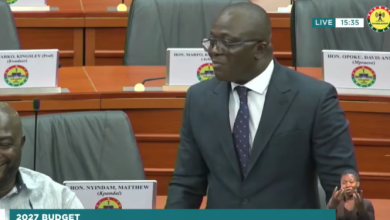
The Member of Parliament for Manso Nkwanta, Tweneboa Kodua Fokuo, has questioned the government’s reserve accumulation strategy, arguing that the country’s foreign reserves have declined despite earlier ambitions to build substantial import cover.
Speaking during the 2027 Budget debate in Parliament on Thursday, November 19, 2026, the Deputy Ranking Member of the Economy and Development Committee said Ghana’s gross international reserves had fallen from US$12.94 billion to US$11.07 billion between June and August 2026.
He described the decline of US$1.87 billion within two months as worrying, questioning the government’s ability to sustain its reserve-building ambitions.
Questions over 15-month import cover target
Mr. Fokuo recalled that the Finance Minister had earlier presented a reserve accumulation policy aimed at building reserves equivalent to 15 months of import cover, a target he said the Minority had questioned.
He said the current reserve position raised concerns about the feasibility of that ambition, particularly as the country was struggling to maintain adequate import cover.
“What has happened that now he’s actually struggling to even build five months?” he questioned.
He argued that excessive focus on reserve accumulation could come at the expense of critical infrastructure and development projects, including classrooms and other essential public investments.
Mr. Fokuo also questioned the GH¢17.2 billion budgeted for transfers to the Gold Board for reserve accumulation in 2027, as well as the reported reallocation of GH¢5 billion from capital expenditure to the Gold Board in 2026.
He further cautioned against Ghana’s growing reliance on gold revenues, which he claimed accounted for about 69 per cent of foreign income, arguing that a significant decline in gold prices could expose the economy to risks.
The MP called for a more balanced approach to reserve accumulation, fiscal management and investments in sectors that directly support economic growth and improve living conditions.
Source: Ghana/otecfmghana.com