Donald Trump has issued a flurry of executive orders on everything from immigration, climate to pardons after being sworn in as the 47th president of the United States.
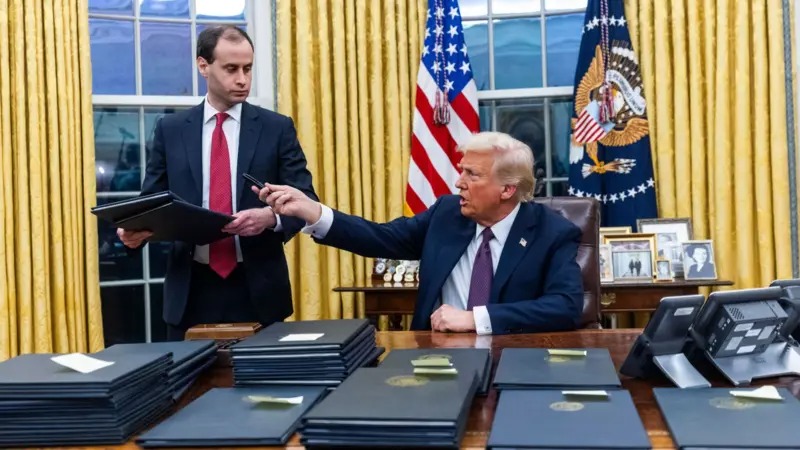
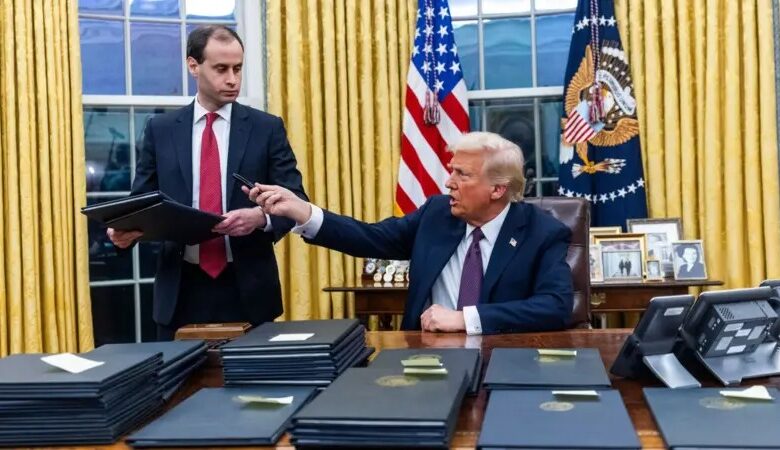
At the White House, the Republican quickly set about using his new powers to sign off on executive actions, presidential memorandums and executive orders on a host of policy priorities.
Executive orders carry the weight of law, but can be overturned by subsequent presidents or the courts.
Several of those enacted by Trump will face legal challenges.
Here is a rundown of what he’s done so far.
Immigration
National emergency at the border
In the Oval Office, Trump signed a directive to declare a national emergency at the southern border. “That’s a big one,” Trump said as he added his signature.
He also targeted automatic citizenship for US-born children of immigrants in the country illegally.
Trump also signed an order that is set to suspend the US refugee resettlement programme for four months, though the details were unclear.
Birthright citizenship
This was one of the most controversial of those signed on Monday, an attempt to deny the right to citizenship to the children of migrants either in the US illegally or on temporary visas.
The 14th Amendment to the US Constitution has long been interpreted to enshrine that right, and Trump’s action was immediately challenged in federal court.
Closing the border
Trump ordered the military to “seal the borders” and cited the flow of illicit drugs, human smuggling and crime relating to crossings.
Terrorism designation for gangs and cartels
The president signed a directive that designates drug cartels and international gangs as foreign terrorist organisations. Salvadoran migrant gang MS-13 and Venezuelan gang Tren de Aragua will be added to a list that includes al-Qaeda, the so-called Islamic State and Hamas.
Resume wall-building
As part of his emergency declaration at the southern border, Trump directed agency chiefs to relaunch efforts to “construct additional physical barriers along the southern border”. The directive is not an executive order and it’s unclear how such an effort might be funded, a key hurdle for Trump during his first term.
When Trump was first elected president in 2016, he signed an executive order to build a border wall. Although some parts of barrier were built, most was left uncompleted.
‘Remain in Mexico’
Trump also re-implemented his “Remain in Mexico” policy in a day-one executive order. A measure from his first term, it returned about 70,000 non-Mexican asylum seekers across the border to await hearings.
Migration policy
In the same order, Trump also shut down a major Biden-era immigration pipeline: a sponsorship initiative that allowed up to 30,000 migrants from Cuba, Haiti, Nicaragua and Venezuela to fly to the US.
This policy, known as CHNV, was designed to lower illegal border crossings, the Biden administration had said.
Death penalty for certain immigrant criminals
Trump signed an executive order reinstating the death penalty. The order details those who the penalty should be used on and includes any “capital crime committed by an alien illegally present in this country” and anyone convicted of murdering a law-enforcement officer.
Deportations
Trump issued an executive order ending the practice of “catch and release”, a policy that allows migrants to live in US communities while they await their hearings.
He has previously promised to “launch the largest deportation program in American history” and end a long-time policy that has kept federal immigration authorities from conducting raids on churches and schools.
His immigration promises could face legal and logistical challenges.
TikTok
Trump also signed a directive postponing the implementation of a law banning Chinese-owned social media platform TikTok for 75 days.
TikTok welcomed Trump’s promises on this and restored US services after briefly switching them off before his inauguration.
Trump had said his order would give TikTok’s parent company more time to find a US partner to buy a majority stake, but details on the directive he signed aren’t clear.
Asked what the action does after he signed it, Trump says it gives him the right to “sell it or close it”.
The new president formerly backed a TikTok ban, but indicated he reversed course after his campaign videos attracted billions of views.
Government reform
Doge and Elon Musk
Trump has signed a directive creating the Department of Government Efficiency (Doge) – a new advisory body that aims to cut government costs. It is expected to be led by Elon Musk.
Trump said Musk, the head of Tesla and SpaceX, will get an office for about 20 employees for the new agency.
Freeze on federal hiring
Trump signed an action halting any new federal hiring – except within the US military and several other categories – until the Trump administration has full control over the government.
Federal employees returning to the office
Trump signed a document mandating that federal workers must work in the office and are not allowed to work from home.
Censorship
Trump signed a directive “ordering the restoration of freedom of speech and preventing government censorship”.
The order directs the attorney general to investigate the activities of officials at such agencies as the Department of Justice, the Securities and Exchange Commission, and the Federal Trade Commission during the previous administration.
Political prosecutions
The new US president signed an executive order that sought to end the “weaponization of government against political adversaries”. The order mandates a review of the work of various law enforcement and intelligence agencies under the Biden administration to “identify any instances” of weaponisation, and then recommend “appropriate remedial actions” against these agencies.
World Health Organization
Trump signed an executive order to begin the process of withdrawing the US from the World Health Organization (WHO).
“Oooh, that’s a big one,” he said as he signed the document. This marks the second time Trump has ordered the US be pulled out of the WHO.
Trump was critical of how the Geneva-based institution handled Covid-19 and began the process of pulling out from it during the pandemic. President Joe Biden later reversed that decision.
Reversing Biden policies
America First
In an executive order, Trump paused foreign aid and outlined he wanted a review of foreign assistance programs. Karoline Leavitt, the White House press secretary, said this was part of a new “American-First” foreign policy.
Cuba
Trump issued a directive to undo Biden’s recent decision to remove Cuba from the US list of state sponsors of terrorism. He could also reinstate sanctions against Venezuela. Both countries were frequent targets of his ire during his first administration.
Biden-era regulations
One of the first directives Trump signed as part of his second term was a document rescinding nearly 80 Biden-era regulations.
Regulatory freeze
Trump signed a directive that froze any federal agency from issuing any new regulations until the Trump administration has full control of the government.
Unvaccinated federal workers
As part of a directive reversing Biden-era policies, Trump revoked a mandate that federal workers must be vaccinated with the Covid vaccine. He has promised to reinstate the 8,000 military service members who were discharged due to the Pentagon’s Covid vaccine mandate – with full backpay.
Diversity and gender
Transgender people
Trump issued an executive order declaring that the US will only recognise “two sexes, male and female. These sexes are not changeable and are grounded in fundamental and incontrovertible reality.”
The order will affect transgender policy regarding government communications, civil rights protections and federal funding, as well as prisons. It will affect official documents like passports and visas.
DEI
In the same executive order, Trump ended all government programmes, policies, statements and communications that promote or support “gender ideology”.
In a separate executive order, he halted all “diversity, equity and inclusion” (DEI) programmes within the federal government. The order is called “ending radical and wasteful government DEI programs and preferencing”. The order covers all federal agencies and includes those that get federal grants, or have federal contracts.
The incoming administration has also promised further actions that may affect the private sector.
Renaming the Gulf of Mexico
‘Gulf of America’
Among Trump’s first executive orders was one that directs the secretary of the interior to change the name of the Gulf of Mexico to the “Gulf of America”.
Alaska’s Mount Denali
The same order also directs the interior secretary to rename Alaska’s Mount Denali to Mount McKinley – in honour of America’s 25th president whose tariff policies Trump admires. President Barack Obama changed the name from McKinley to Denali to reflect what it was called by native tribes. It is the highest mountain peak in North America.
Economy
Tackling inflation
He signed a directive asking every US federal department and agency to address the cost of living for Americans. The directive, which is not an executive order, asks agencies to look at lowering the costs of housing, healthcare and key household items, groceries and fuel.
It asks for a report in 30 days. It’s not clear how the Trump administration intends to lower these costs, and it’s not detailed in the directive.
Climate and energy
Pull out of the Paris agreement (again)
As part of the first batch of directives, Trump signed off on withdrawing from the Paris climate agreement – the landmark international deal designed to limit rising global temperatures.
It was among the first documents Trump signed after his inauguration.
Trump first withdrew from the Paris accord in 2017, before Biden re-entered it in 2021.
Along with signing off on exiting the deal, Trump also signed a letter that will be sent to the United Nations explaining the withdrawal.
National energy emergency
Trump declared a national energy emergency, promising to fill up strategic oil reserves.
He signed an executive order titled “unleashing Alaska’s extraordinary resource potential”, which deals with oil and gas and other natural resources.
The new president vowed to “drill, baby, drill” for more American fossil fuels.
End Green New Deal
As part of an executive order on energy, Trump halted the so-called green new deal, a series of Biden administration measures that were aimed at boosting green jobs, regulating the fossil fuel industry and limiting pollution.
Trump ordered agencies to halt funds appropriated through two laws, the Inflation Reduction Act and another law on infrastructure and jobs.
He also said the US would end leasing to wind farms and revoke what he has called an electric vehicle “mandate”.
Capitol riot
Pardoning nearly 1,600 people who stormed US Capitol
Trump announced he was issuing pardons for nearly 1,600 of his supporters who were arrested in the riot at the US Capitol in 2021.
Trump has repeatedly referred to those arrested in the riot as “hostages”. At least 600 were charged with assaulting or impeding federal officers.
Commuting sentences of Oath Keepers, Proud Boys
Trump also commuted sentences for members of the Oath Keepers and Proud Boys, far-right groups, who were convicted of seditious conspiracy in relation to the Capitol riot.
A lawyer for former Proud Boys leader Henry “Enrique” Tarrio, who was jailed for 22 years for seditious conspiracy over the riot, said his client also expected to be released.
What Trump hasn’t acted on – yet
Tariffs
After bracing for weeks for a trade war with the US, Canada has – for now – evaded tariffs that Donald Trump had threatened to impose on the country as soon as he takes office.
But Trump said on Monday the tariffs on Canada and Mexico could come on 1 February and ordered federal officials to review US trade relationships for unfair practices, including those with Canada, Mexico and China.
The incoming president pledged import duties of 25% on Canada and Mexico, as well as 10% on global imports and 60% on Chinese goods.
Secret documents
At a rally on Sunday, Trump said he would release classified documents related to the assassination of President John F Kennedy in 1963, a subject of countless conspiracy theories, as well as the 1968 killings of Senator Robert Kennedy and civil rights leader Martin Luther King Jr.
Crypto pile
Trump has championed cryptocurrency, and his election saw the value of Bitcoin increase by 30%.
Some believe Trump will move quickly to create a federal “Bitcoin stockpile” – a strategic reserve similar to the US’s stockpile of gold and oil – that he has said would serve as a “permanent national asset to benefit all Americans”.