“Berekum is angry”: Residents demand end to mining as Amoma River suffers
The people of Berekum and adjoining communities have delivered an uncompromising message to government, mining regulators and all prospective miners: they want no form of mining on their lands.
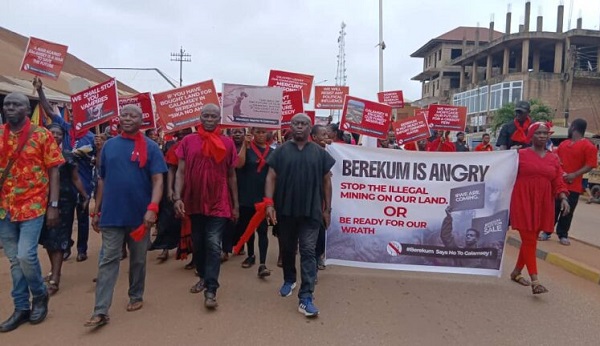
Hundreds of residents, farmers, youth groups, traditional stakeholders and civil society actors from Berekum, Amomaso, Benkasa, Nsapor and Nanasuano took to the streets in a massive demonstration against illegal mining, popularly known as galamsey, accusing the practice of poisoning the Amoma River, destroying farmlands and threatening the future of agriculture in the Berekum Traditional Area.
Under the theme, “Berekum is Angry, Stop the Illegal Mining on Our Land or Be Ready for Our Wrath,” the protesters marched through the principal streets of Berekum, chanting, drumming and displaying placards that captured their deepening frustration over the degradation of their natural resources.
The demonstrators, many of them women dressed in red and black, assembled at the Presbyterian Park at about 8 a.m. before embarking on the protest march.
Their message was stark: Berekum does not want mining, illegal or otherwise, if it threatens the land, water bodies, forests and agricultural heritage of the people.
Amoma River at the centre of the crisis
At the heart of the residents’ concerns is the Amoma River, once a dependable source of water for domestic activities and agricultural purposes.
Residents say illegal mining activities have increasingly contaminated the river, raising serious concerns about water security, food production and the health of communities that depend on the river.
For generations, farming has been a major economic lifeline for families across the Berekum Traditional Area. But residents say the destruction of farmlands and pollution of water bodies are steadily undermining that foundation.
The communities fear that if the situation is allowed to continue, they could eventually be forced to import drinking water and struggle to sustain agricultural production on lands that have supported generations.
Some of the placards carried by protesters captured the depth of their concerns.
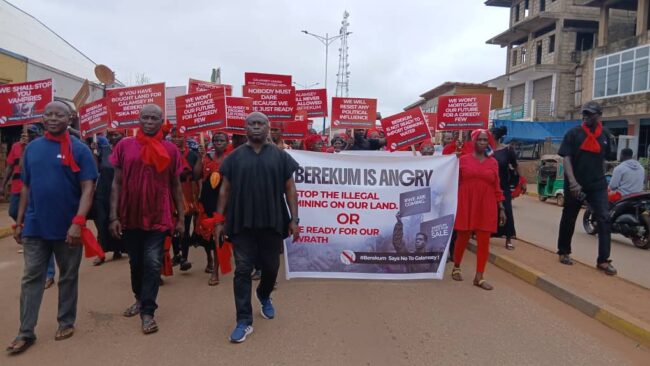
They included: “Berekum is Not Ready to Import Drinking Water,” “Nobody Can Take Berekum for Granted,” “We Won’t Mortgage Our Future for a Greedy Few,” “If You Have Bought Land for Galamsey in Berekum, Sika No Ahyɛ,” and “Galamsey is Eroding Our Forest.” ‘We don’t want any form of mining in Berekum’.
One of the conveners of the demonstration, Nana Oppong Boateng Dartey, the Dabehene of the Berekum Traditional Area and the Chairman of Berekum Citizens and Associates, said the extent of environmental destruction caused by illegal mining had left the people with no appetite for mining activities of any kind.
He said the devastation of farmlands and water bodies had reached a point where the people could no longer remain silent.
Nana Oppong Boateng Dartey stressed that the people of Berekum were unwilling to exchange their natural resources and agricultural future for short-term economic gains from mining.
He said the position of the people was clear and unequivocal: Berekum does not want mining activities that could permanently damage its environment and livelihoods.
Beyond the destruction of the environment, the protesters expressed concern about the potential health consequences of prolonged exposure to pollutants and hazardous chemicals associated with illegal mining, particularly mercury.
They warned that the contamination of water bodies could expose residents to serious long-term health risks while further weakening the ecological systems upon which farming and other economic activities depend.
The protesters therefore called for stronger enforcement of environmental laws and intensified action against individuals and groups engaged in illegal mining.
The demonstration was organised by Berekum Citizens and Associates, in collaboration with the Berekumman Citizens Association and Berekum Youth for Development and Accountability, with support from affected farmers and residents.
The organisers described the fight against galamsey as a collective responsibility, stressing that the future of Berekum could not be secured through isolated efforts.
They said they had, over the years, engaged relevant stakeholders on sustainable ways of addressing illegal mining and protecting the environment.
According to the organisers, the demonstration was therefore not an isolated event but part of a broader campaign to strengthen advocacy and ensure that the collective concerns of residents are heard at the highest levels.
The latest protest also follows a similar demonstration staged by traditional leaders and residents of Berekum in April 2026, when the people took to the streets to protest the destruction of the Amoma River and farmlands by galamsey activities.
Throughout the march, protesters called on the government, traditional authorities, the Minerals Commission and other regulatory institutions to intensify efforts to halt illegal mining and enforce environmental protection laws.
They insisted that the fight against galamsey must move beyond public statements to concrete enforcement measures capable of protecting water bodies, farmlands and forest reserves.
For the residents, the struggle is not simply about stopping illegal miners from operating.
It is about protecting the very foundation of life in Berekum the land, the rivers and the farms that sustain families and preserve the heritage of generations yet unborn.
A petition was expected to be presented to the Member of Parliament for Berekum East, Simon Ampabeng Kyeremeh, but the presentation could not take place after the MP was reportedly called away on an emergency.
However, speaking to the protesters, Kyeremeh said he was opposed to illegal mining and pledged to resist any attempt to engage in galamsey in Berekum.
He assured the residents that he did not support activities that would destroy the environment and livelihoods of his constituents.
Report by Daniel Donkor, Bono Region