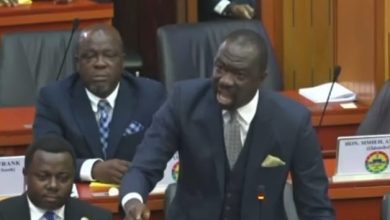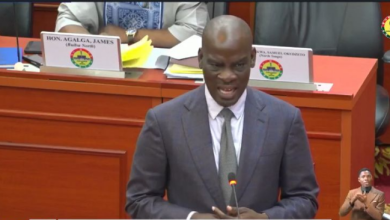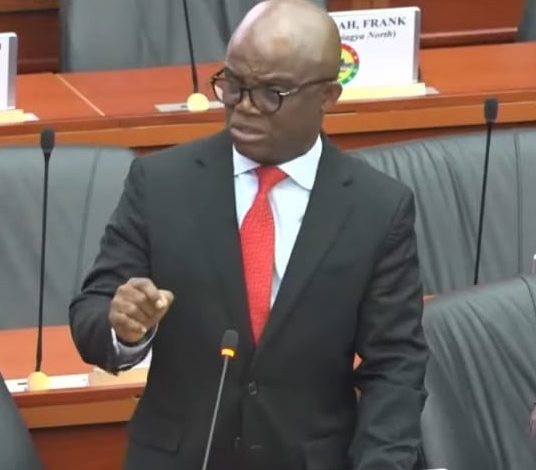
The Member of Parliament (MP) for Nhyiaeso in the Ashanti Region and Deputy Ranking Member, Amoah Stephen, has defended the economic performance of the previous New Patriotic Party (NPP) administration, insisting that it successfully restored Ghana’s economy despite the devastating impact of the COVID-19 pandemic.
Contributing to the debate on the 2027 Budget Statement in Parliament on Wednesday, November 18, 2026, Mr Amoah argued that the NPP government inherited an unprecedented global economic crisis but implemented measures that helped revive the economy before handing over power.
He dismissed claims by the Majority side that the previous administration had mismanaged the economy through excessive borrowing, describing such assertions as politically motivated and a misrepresentation of the economic circumstances at the time.
According to him, economic management must be assessed within the context of prevailing global conditions and the fiscal challenges confronting governments.
“You just don’t wake up and borrow. You just don’t wake up and take any decision at all to disorganise and destroy the needed equilibrium of the underlying elements of your fiscal space,” he stated.
COVID-19 Crisis Tested NPP’s Economic Management
Mr Amoah said the 2019 and 2020 period represented one of the most difficult moments in global economic history, with Ghana experiencing significant disruptions to economic activities.
He recalled that public and civil servants were paid despite being asked to stay home, while more than 40,000 Ghanaian workers were reportedly laid off by private-sector employers.
He further noted that the global economy contracted by approximately three per cent in 2020, while Ghana’s economic growth slowed to about 0.5 per cent.
The situation, he explained, resulted in a revenue shortfall of approximately GH¢12 billion, forcing the government to rely on debt financing to sustain economic activities and protect livelihoods.
“Government had to rely on debt financing to save this country and elsewhere,” he told Parliament.
He argued that the economic difficulties experienced during the period should not be attributed solely to poor economic management, insisting that the government had been confronted with extraordinary circumstances.
NPP Restored Economy Before Leaving Office
The Nhyiaeso MP maintained that the NPP administration made significant progress in restoring the economy before leaving office in 2024.
He cited improvements in economic growth and inflation, indicating that Ghana’s economic growth had recovered from 0.5 per cent in 2020 to between 5.6 and 5.8 per cent by 2024.
He also claimed that inflation had declined from 54.1 per cent to approximately 22.8 per cent during the period under review.
On public debt, Mr Amoah argued that Ghana’s debt-to-GDP ratio, which had risen significantly during the pandemic, was reduced to 61.8 per cent before the NPP left office.
He insisted that the previous administration deserved recognition for the economic recovery achieved despite the global challenges.
“If any government has to be praised today, it is the NPP government that healed the sick nation economically,” he stressed.
He, however, acknowledged improvements in some of the country’s primary macroeconomic indicators under the current Finance Minister, Dr Cassiel Ato Forson, but questioned the government’s ability to translate those gains into improved living conditions for ordinary Ghanaians.
Questions NDC’s 24-Hour Economy Policy
Turning his attention to the NDC government’s flagship 24-hour economy policy, Mr Amoah questioned its implementation, arguing that the initiative had yet to deliver the promised economic benefits.
He suggested that the policy had lost momentum, using a metaphor of a clock whose battery had run out to describe what he considered the government’s failure to operationalise the initiative.
“The last time I checked, the 24-hour clock on the wall, the battery is dead. The batteries in the 24-hour economy block are dead. Where is the 24-hour economy?” he asked.
He further challenged the government to identify factories and businesses that had expanded their operations into multiple shifts as a result of the policy.
Cites Declining Growth in Agriculture and Services
Mr Amoah also questioned the performance of key sectors of the economy, particularly agriculture and services, citing figures contained in the government’s own 2027 Budget Statement.
Quoting from page 48 of the budget document, he said the agricultural sector recorded a growth rate of 3.9 per cent in the first half of 2026, compared with 6.8 per cent during the corresponding period in 2025.
He also cited the services sector, which reportedly grew by 7.5 per cent in the first half of 2026, down from 8.5 per cent recorded in the same period of the previous year.
According to him, the figures suggest that although improvements may have been recorded in the primary macroeconomic indicators, the performance of sectors that directly influence employment, productivity and household incomes remains a concern.
“The most important sectors that are driving the economy of this country and impacting lives are declining. You stated that; I am not the one. It is here in your own budget,” he said.
He maintained that the government must move beyond celebrating improvements in macroeconomic indicators and demonstrate how those gains are translating into tangible economic relief for citizens.
Mr Amoah concluded by urging Parliament to move beyond partisan arguments and focus on policies that would improve the economic conditions of Ghanaians.
He insisted that economic recovery should not be measured only by figures presented in budget statements but also by the extent to which ordinary citizens experience improvements in their daily lives.
Source: Ghana/otecmfghana.com/John Antwi Boasiako