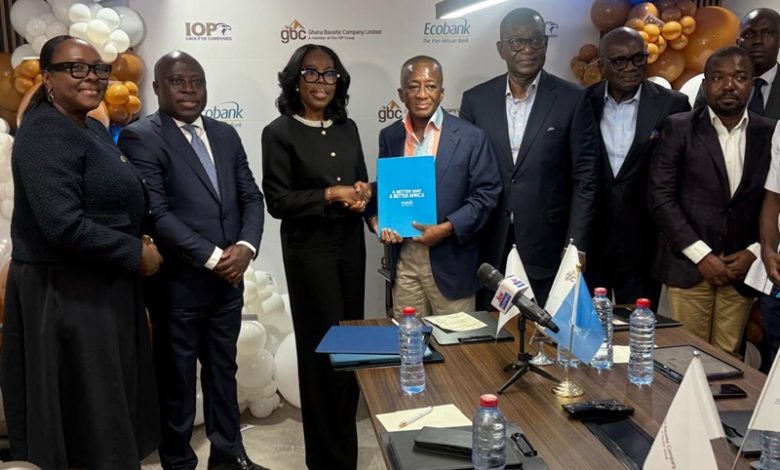
The Ghana Bauxite Company Limited (GBC) has signed a strategic financing agreement with Ecobank Ghana PLC to mobilise up to US$250 million to support the company’s expansion and advance Ghana’s ambition of developing a fully integrated aluminium industry.
Under the agreement, Ecobank Ghana has been appointed the exclusive mandated arranger responsible for structuring and syndicating the proposed financing, which is expected to support mining operations, major capital expenditure and working capital requirements.
The signing establishes a framework for mobilising the funds, although it does not in itself confirm that the full amount has been raised or disbursed.
The financing will support the upgrading of GBC’s Awaso mine in the Bibiani-Anhwiaso-Bekwai Municipal District of the Western North Region.
It will also facilitate the modernisation of material handling, logistics and processing systems to improve operational efficiency and enable the company to handle increased production volumes.
The partnership is expected to contribute to Ghana’s broader industrialisation agenda, spearheaded by the Ghana Integrated Aluminium Development Corporation (GIADEC), to transform the country from a raw bauxite exporter into an integrated aluminium producer.
For decades, Ghana has exported raw bauxite while importing refined alumina at considerable cost to supply the Volta Aluminium Company Limited (VALCO) smelter at Tema.
Under the leadership of Executive Chairman Mr Isaac Ofori-Poku, GBC has recorded significant growth through the adoption of surface-mining technologies.
The company’s bauxite exports increased from 773,213 metric tonnes in 2022 to 2.07 million metric tonnes in 2025, reflecting its expanding production and export capacity.
Speaking at the agreement signing, Mr Ofori-Poku said Ghanaian businesses had a responsibility to demonstrate that they could do more than participate in resource extraction.
He noted that local companies possessed the vision and technical expertise required to build and manage platforms capable of transforming raw resources into lasting economic value.
“Our responsibility is to demonstrate that Ghanaian businesses can do far more than merely participate in resource extraction. We possess the vision and technical capability to build and manage the platforms required to transform raw resources into lasting economic value”, Mr. Isaac Ofori-Poku stated.
As part of its long-term strategy, GBC plans to construct a modern alumina refinery at Awaso, with an initial production capacity of 500,000 metric tonnes annually and a long-term target of 1.5 million metric tonnes per year.
Geological and metallurgical assessments are underway to optimise the use of the company’s bauxite deposits for both export and domestic refining, with the proposed refinery expected to address a major gap in Ghana’s aluminium value chain.
The Managing Director of Ecobank Ghana PLC, Abena Osei-Poku, on her part, said transformative industrial projects required strategic financial expertise and partnerships with organisations that understood both the commercial opportunities and national responsibilities involved.
“Transformative industrial projects demand strategic financial expertise and partners who comprehend both the commercial opportunity and national responsibility,” she said.
She added that Africa’s ambitions needed to be matched by its capacity to mobilise capital.
The successful implementation of the financing arrangement and the proposed refinery project is expected to create thousands of local jobs, attract foreign direct investment and retain a greater share of Ghana’s natural resource wealth within the country.
The partnership also seeks to strengthen domestic industrial capacity and enable Ghana to capture more value from its bauxite resources rather than relying heavily on the export of raw materials.
Source: Ghana/otecfmghana.com/Francis Appiah