Sky Train Project discussed at multiple board meetings – AG witness
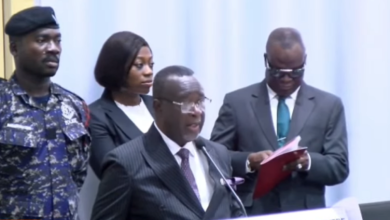
The second prosecution witness of the Attorney General in the case of the Republic versus Solomon Asamoah and another (Sky Train Case) has confirmed in court that the Sky Train Project was discussed at multiple board meetings and that, as board secretary, he took minutes of those meetings.
Mr Kofi Boakye, the former board secretary of the Ghana Infrastructure Investment Fund (GIIF) answering questions from the lawyer for the first accused person Ms Victoria Barth ESQ., admitted that one Harriet Abban, as an independent lawyer, and successor corporate secretary of GIIF, effectively cautioned him (Kofi Boakye) that the minutes of the 24 October 2018 board meeting show a board approval of the Sky Train project.
The witness stated in court that he disagreed with Ms. Abban and explained to her that what she referred to as express approval by the GIIF board could not have occurred.
In his submission, Mr. Kofi Boakye also claimed that the memo from the finance department and the former CEO requesting the disbursement of the 2 million dollars for the project was carried out in May 2018, which was several months before the project was even discussed at the October 2018 Board meeting.
This was the major reason why he felt the Board could not have approved the project before the funds were disbursed. However, after the defence lawyer showed him the memo and he confirmed this was the document he was referring to, she asked him to confirm the date of the memo.
He admitted that it was in fact dated 25 February 2019, which was 4 months after the October 2018 board meeting, and therefore his assertion that it was sent in May 2018 had been wrong.
Further contradictions
During cross-examination, the witness made a categorical statement which sharply contradicted what the prosecution’s first witness had told the court.
“If my lady would have a look at my witness statement, I stated in there that the Sky Train matter was a matter that was mentioned at several board meetings, so it would not be out of place if one were to find that in the minutes,” Kofi Boakye, who was an Acting Board Secretary of the GIIF, said.
This statement sharply contradicted the first prosecution witness, Yaw Odame-Darkwa’s claim that “the Sky Train concept was only introduced at one of our board meetings.”
Victoria Barth, counsel for Mr. Asamoah, focused on the minutes of the GIIF board meeting in October 2018 that recorded the Sky Train project as approved which stated in part, “following the approval by the board that the sum of US$2 million be invested in the Accra Sky Train project…”
Despite being the author of these minutes, Kofi Boakye still maintained that this did not constitute a record of the board approval. He further stated that after he had left the GIIF Board in 2020 that:
“…the Public Accounts Committee had raised an issue that related to the Sky Train project, so the company secretary, Ms Abban, together with the Chief Accountant, called me, and I told them that the Sky Train project was never approved by the board.
“It was around that time that Ms. Abban drew my attention to the minutes of 24th October, 2018, that is exhibit 4, that there was a sentence in there that states that the board had approved the project. I reiterated to her that the board never approved the project,” the witness claimed.
“According to your own testimony this morning, but for your independent explanation or clarification to Ms. Abban and the Chief Accountant about four years after exhibit 4 (minutes of 24 October 2018) were signed, Ms. Abban and the Chief Accountant had understood that there was a sentence in exhibit 4 that indicated the board approval of the Sky Train project,” Mrs. Barth asked.
“My evidence this morning was that Ms. Abban called me, and at all times, I made her understand that the Sky Train project was not approved. Then she drew my attention to exhibit 4, and my response was that that sentence did not constitute an approval of the board…” he responded.
The lawyer then accused him of embellishing his earlier testimony about what Ms. Abban told him, noting that Exhibit 4 shows the board approved the Sky Train project.
“Far from testifying to matters that never happened, the question that was posed by counsel was that Ms. Abban “understood the words in exhibit 4 to constitute an approval.” That was the question, so it is important to state the fact as they are,” the witness answered.
“It is not correct that Ms. Abban told you that the CEO had referred to the minutes of 24th October 2018 as the record for the board approval. No such conversation ever occurred,” the lawyer pushed.
Kofi Boakye, in his response, said that, during his conversation with Ms Abban in the presence of other board members, the CEO insisted that the minutes of October 24, 2018, constituted the record showing that the board had approved the Sky Train project.
Mrs. Barth then pointed out to the witness that Ms. Abban was not present at the National Intelligence Bureau (NIB) when the “CEO insisted that the minutes of 24th October 2018 captured the board approval of the Sky Train project” and so it could not have been stated in her presence.
“No, she was not,” the witness agreed. The case was adjourned to February 17, 2026, for continuation.
Background
In 2019, the Ghana Infrastructure Investment Fund (GIIF) invested US$2 million for a 10% stake in Africa Investor Skytrain Consortium Holdings (“Ai Skytrain”), the company developing Accra’s Skytrain light railway project.
The Africa Investor Group (the “Sponsors”) was selected and granted the rights to develop the project by the Government of Ghana (“GoG”) through the Ministry of Railways Development (“MORD”).
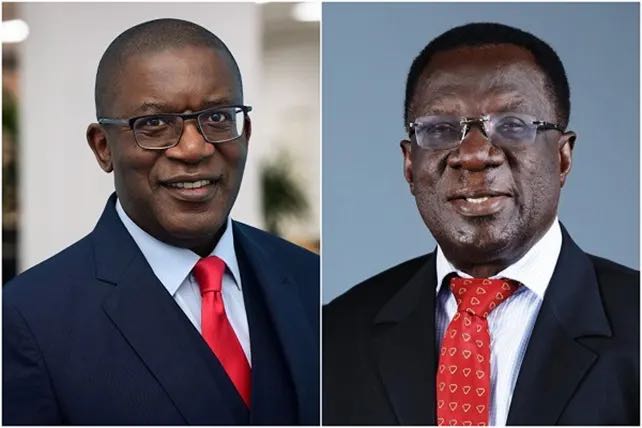
At the time, the Chairman of GIIF was Professor Christopher Ameyaw-Akumfi, and the Chief Executive Officer (CEO) was Mr Solomon Asamoah.
The Chairman had previously been a member of the GoG. Mr. Asamoah was an international development banker who had been headhunted for the position by a UK recruitment agency.
Following a change of government in Ghana in December 2024, the GoG, through the office of the Attorney General of Ghana, now alleges that this action was taken without Board approval, resulting in a willful financial loss to the state, as there is as yet “no railway built”.
It should be noted that there are no allegations of personal gain or diversion of funds in the charges, and the state has not charged anyone from MORD or the GoG-selected sponsors; only the GIIF Chairman and CEO have been charged.
The state witnesses who initially faced charges of causing financial loss to the state themselves dropped these charges after stating they did not approve the project, casting significant doubt on the reliability of their statements.
The prosecution’s case is built almost entirely on these statements to show that a legitimate transaction was “unauthorized”, without which there would be no case to answer.
“The prosecution’s case appears to be politically motivated, intended to fulfill a campaign promise to prosecute members of the previous government. It is unsupported by the facts, relying on demonstrably false witness statements,” a lawyer familiar with the case stated on condition of anonymity.