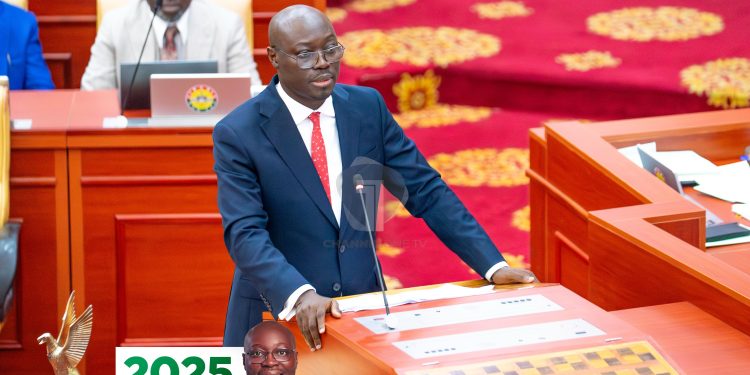
Mr. Speaker, permit me to extend my profound gratitude to you and to Honourable members of this House for the opportunity to present this important policy statement.
Mr. Speaker, Ghana achieved a decisive macroeconomic turnaround in 2025 following the 2022–2023 economic crisis. By the end of 2025:
⦁ Real GDP growth averaged 6.1% in the first three quarters of the 2025.
⦁ Inflation declined sharply from 23.8% in 2024 to 5.4% and further down to 3.8% in January 2026;
⦁ Interest rates fell sharply, with the 91-day Treasury bill dropping from 27.7% at the end of 2024 to 11.1% in December and further down to 6.4% in February 2026;
⦁ The primary balance on a commitment basis improved significantly from a deficit of 3.0% in 2024 to a surplus of 2.6% of GDP;
⦁ Public debt declined sharply from 61.8% of GDP in 2024 to 45.3% of GDP;
⦁ The current account posted a surplus of US$9.1 billion, up from US$1.5 billion in 2024;
⦁ The cedi appreciated by 40.7% against the US Dollar, 30.9% against the British Pound and 24.0% against the Euro; and
⦁ Gross international reserves increased to US$13.8 billion, representing 5.7 months of import cover from US$8.9 billion, equivalent 4.0 months of import cover in 2024.
Mr. Speaker, the current Gross International Reserve level is above the traditional reserve benchmark of three months of import cover. This is, however, not sufficient to provide adequate self- insurance against disruptive economic shocks and its impact on the exchange rate like the historical cedi depreciation in 2022–2023.
To strengthen Ghana’s resilience to economic shocks, Cabinet has approved the Ghana Accelerated National Reserve Accumulation Policy (GANRAP). The Policy presents Ghana’s strategic plan to strengthen external resilience by increasing the nation’s International Reserves to an equivalent of fifteen (15) months of import cover by end-2028.
Mr. Speaker, the policy is anchored on the objectives of the Ghana Gold Board Act, 2025 (Act 1140) which mandates the Ghana Gold Board to generate foreign exchange for the country and support gold reserve accumulation by the Bank of Ghana. The policy is also informed by the country’s cycle of economic downturns, recent macroeconomic developments, global risk assessments, and Ghana’s long- term economic transformation agenda.
BACKGROUND AND POLICY CONTEXT
Mr. Speaker, historically, Ghana has relied heavily on inflows from gold, cocoa, and crude oil exports to build international reserves. However, over the last decade, the country has relied largely on costly swaps, sale and buy-backs and other short-term facilities as well as Eurobond borrowings to build international reserves, resulting in significant debt service obligations.
Mr. Speaker, these developments in the last decade, led to the unsustainable debt situation in 2022, the resultant debt default and restructuring and subsequent request for an IMF-supported ECF programme in May 2023. Mr. Speaker, despite cocoa’s historical importance, its contribution to sustained foreign exchange stability has been undermined by price volatility, low productivity, climate risks, and limited value addition.
Crude oil, which initially promised to provide fiscal relief and Balance of Payments support, is now declining due to lack of investment in the last eight years and waning investor confidence resulting in six years of consistent oil output decline.
RATIONALE FOR A STRATEGIC RESERVE BUILD‑UP
Mr. Speaker, despite the progress made in 2025, growing global uncertainties make Ghana vulnerable to:
⦁ external financing volatility;
⦁ commodity price cycles;
⦁ global geopolitical tensions;
⦁ climate‑related disruptions; and
⦁ regional security risks.
These have simultaneously lifted gold prices to historic highs and provide an opportunity for Ghana to build reserves to secure the country’s external sector against any major shock to strengthen Ghana’s first line of defence. Mr. Speaker, given these uncertainties, the conventional threshold of three months of import cover is no longer adequate.
Government therefore seeks to accumulate a strategic buffer beyond the conventional reserve adequacy levels and build an “economic war‑chest” of 15 months of import cover by end-2028 to:
⦁ Safeguard macroeconomic stability;
⦁ Break the cycle of economic downturns;
⦁ Sustain confidence in the currency;
⦁ Improve investor confidence;
⦁ Reduce exposure to external shocks; and
⦁ Support long‑term economic transformation.
Mr. Speaker, the objective of this policy is to build reserves to 15 months of import cover to support Ghana’s long-term economic transformation without compromising macroeconomic stability.
HISTORICAL SIGNIFICANCE
Mr. Speaker, this strategy is not new. After the 1997 Asian Financial Crisis, the most affected countries embarked on aggressive foreign reserve accumulation as a key policy response. This was driven primarily by a desire for self-insurance against future sudden capital reversals and crises following the traumatic experience of relying on IMF bailouts, which came with strict conditions.
Mr. Speaker, this helped these economies fare much better during later shocks, like the 2008 Global Financial Crisis, without depleting their reserves. Mr. Speaker, a diagnosis of Ghana’s reserve trajectory shows a pattern of episodic accumulation linked to opportunistic external borrowings and seasonal cocoa export inflows, followed by drawdowns to meet external obligations.
Mr. Speaker, from a reserve position of 5.4 months of import cover in April 2021, following an Eurobond issuance of US$3 billion, reserves sharply declined to a low of under 2.3 months of import cover in September 2023. The depletion reflected a strain on external buffers in the face of constrained financing options, capital outflows, heightened macroeconomic pressures, and the need to meet critical foreign exchange obligations.
RECENT GOLD MARKET DYNAMICS AND IMPLICATIONS FOR RESERVE ACCUMULATION
Mr. Speaker, global gold prices have reached unprecedented levels, driven by heightened international risk, sustained accumulation by central banks, and strong safe-haven demand. These developments significantly boosted export earnings and strengthened external buffers for gold-producing economies, including Ghana.
Mr. Speaker, with prices far exceeding their long-term historical averages, gold has emerged as the most reliable and immediate instrument for accelerating reserve accumulation without increasing public debt or introducing distortions in domestic markets. Projections from major international financial institutions indicate that gold prices are likely to remain elevated and favourable over the medium term, underscoring the resilience and persistence of the current price cycle.
Mr. Speaker, the outlook for gold prices provides a solid foundation for policies that strengthen external buffers, reduce vulnerability to external shocks, and support long-term financial stability. Harnessing this momentum will be essential to building a more robust and resilient reserve-management framework capable of withstanding future global volatility.
The sustained elevation in global gold prices presents a strategic opportunity for gold-producing countries to further enhance their reserve-building frameworks, reinforce their external positions and enhance macroeconomic resilience.
MAJOR GOLD PRODUCERS AND CENTRAL BANKS LEVERAGING HIGH GOLD PRICES FOR RESERVE ACCUMULATION
Mr. Speaker, major gold-producing countries and Central Banks are capitalising on historically high gold prices by increasing production, exports, and official purchases to strengthen their external buffers. China, the world’s largest producer, continues to expand domestic refining capacity and use gold both as a key export and as a strategic reserve asset for diversification.
Similarly, Russia has leveraged on this elevated price environment to boost gold export revenues and channel part of the proceeds into reserve accumulation, using gold as a shock absorber against financial sanctions and global volatility. Australia benefits from high prices through stronger export receipts, improved terms of trade, and higher fiscal and external surpluses, which indirectly support reserve strength.
Mr. Speaker, across these countries, elevated gold prices are being deliberately used to enhance foreign exchange inflows, support balance of payments resilience, and reinforce reserve positions amid heightened global uncertainty. This current gold price surge presents a timely opportunity for Ghana to leverage the country’s gold resources to accelerate reserve accumulation and reinforce long-term external resilience.
POLICY OBJECTIVE AND TARGETS (2026-2028)
Mr. Speaker, the primary objective of the Ghana Accelerated National Reserve Accumulation Policy is to increase Ghana’s international reserves to fifteen (15) months of import cover by end‑2028 to support long‑term structural transformation while safeguarding macroeconomic stability.
To achieve this, the following intermediate targets are set:
⦁ Achieve a minimum of 8.6 months of import cover by end‑2026;
⦁ Exceed 11.8 months by end‑2027; and
⦁ Reach 15 months by end‑2028.
Mr. Speaker, these milestones will be reviewed annually based on realised imports, prices, production volumes, and financing conditions.
QUANTITATIVE ACCUMULATION PATH AND FINANCING FRAMEWORK
⦁ Mr. Speaker, with our gross international reserve at 5.7 months of import cover as at end-2025, the gap to achieve the target of 15 months is 9.3 months.
⦁ This implies an average annual accumulation of 3.1 months of import cover, over three years.
⦁ In 2025, Ghana accumulated additional gross international reserves of 1.6 months of import cover. This provides momentum for the country, but must be accelerated to achieve the average 3.1 months of import cover.
⦁ Mr. Speaker, to secure the target after netting out debt service, FX operations, energy sector payments, and statutory outflows, the strategy requires an average of US$9.5 billion annual addition to the country’s gross international reserves.
⦁ Mr. Speaker, to achieve the reserve accumulation target, the GANRAP has set an operational weekly gold purchase target of approximately 3.02 tonnes.
⦁ At 3.02 tonnes per week and a price of US$5,000 per ounce, annual gross receipts are projected at approximately US$25.28 billion.
⦁ Mr. Speaker, Ghana’s strategy for the acquisition of the 3.02
tonnes of gold per week is in twofold:
⦁ The Ghana Gold Board to acquire a minimum of 2.45 tonnes of gold per week from the Artisanal Small-scale Mining (ASM) sector. The Ministry of Finance will be making budgetary allocations to the Ghana Gold Board to achieve the objective of the policy; and
⦁ The Minister for Lands and Natural Resources, to invoke the preemption right under section 3(d) of the Ghana Gold Board Act, 2025 (Act 1140) and section 7 of the Minerals and Mining Act, 2006 (Act 703) to purchase a minimum of 0.57 tonnes of gold per week from the
large scale gold mining sector.
⦁ The Bank of Ghana will purchase the gold acquired from the large-scale mining sector.
⦁ Mr. Speaker, the gold purchased under section 3(d) of the Ghana Gold Board Act, 2025 (Act 1140) and section 7 of the Minerals and Mining Act, 2006 (Act 703) shall only be sold by the central bank subject to prior approval of Cabinet and Parliament.
POLICY DIRECTIONS
Mr. Speaker, the following measures will be implemented in the short to medium term.
Large-Scale Sector Operations
Mr. Speaker, A change in the current acquisition arrangement of 20% of large-scale gold output by the Bank of Ghana (BoG) will be implemented in the short-term:
⦁ To ensure compliance by the large-scale mining companies, Government shall establish an Inter-Agency Committee, co-chaired by the Minister for Lands and Natural Resources and the Minister for Finance, with members made up of the Governor of the Bank of Ghana and the Chief Executive Officers of the Minerals Commission and the Ghana Gold Board.
⦁ The Minister of Lands and Natural Resources shall invoke the preemption right under section 3(d) of the Ghana Gold Board Act, 2025 (Act 1140) and section 7 of the Minerals and Mining Act, 2006 (Act 703) to purchase a minimum of 20% of large-scale gold output, which translates to a minimum of 0.57 tonnes of gold per week.
⦁ The gold acquired from the large-scale mining sector shall strictly be in the form of doré and processed in Ghana to promote local value addition.
⦁ The transaction shall be in cedis only, at the prevailing interbank exchange rate and at a discount to be determined by the parties. The applicable discount rates shall be determined based on volume.
Mr. Speaker, the purchased gold (doré) under this new acquisition arrangement shall be refined by local gold refineries, shipped to LBMA refineries for melting, bar casting, and stamping, and added to the country’s physical gold reserves. Mr. Speaker, this gold shall only be sold by the central bank subject to prior approval of Cabinet and Parliament.
Mr. Speaker, these measures will ensure strict enforcement of commitments by large-scale mining firms, local value retention, transparency, good governance and acquisition cost reduction, while supporting local gold refineries to attain LBMA certification standards. Mr. Speaker, the Ghana Gold Board, as the national assayer, is strategically positioned to enforce this newly proposed acquisition arrangement as it maintains field officers in the gold rooms of all large-scale mining firms and assays samples from large-scale gold output before export. The Ghana Gold Board has successfully piloted this new acquisition arrangement with nine (9) large-scale mining firms in the last six (6) months.
Artisanal and Small-Scale Mining Sector (ASM) Operations
Mr. Speaker, the Ghana Gold Board will put in place strategies to efficiently mop adequate volumes of ASM gold output, minimum of 2.45 tonnes weekly, through official channels to generate adequate foreign exchange for the country. Mr. Speaker, over the next three (3) years, the Ghana Gold Board will aim to mop up about 127 tonnes of ASM gold per annum. This, at current price levels, will generate over US$20 billion in foreign exchange for the country annually.
Mr. Speaker, to achieve this objective in an efficient manner the following policy measures will be implemented in the Artisanal and Small-Scale Mining (ASM) sector:
⦁ The Ghana Gold Board shall arrange enough funds to acquire about 3 to 4 weeks of gold and ensure continuous market participation.
⦁ The Ghana Gold Board will assume full responsibility for the signing of off-take agreements and the sale of all ASM gold it procures effective March 2026. This will ensure effective end-to-end trading with off-takers and mitigate trading losses while pursuing trading gains for the country.
⦁ The Ghana Gold Board shall deploy effective gold- backed derivative trading programmes and hedging strategies to mitigate market risk.
⦁ To disincentivise smuggling and ensure that adequate volumes of ASM gold are purchased, the Ghana Gold Board may employ price incentives through spot world market price purchases and bonuses for licensed miners.
Mr. Speaker, in the medium term, the Ghana Gold Board will promote ASM formalization, value-chain traceability and local gold refining to further reduce cost while maximising returns from gold exports in a sustainable manner. Mr. Speaker, the Bank of Ghana and the Ghana Gold Board shall sign an agreement which mandates the Ghana Gold Board to sell the foreign exchange accrued under this policy to the Bank of Ghana only, at a cost determined by the two parties.
The Ghana Gold Board is mandated to employ trading reforms to reduce its operating cost. The Ghana Gold Board to facilitate the establishment of modern LBMA-compliant processing plants in partnership with private investors to optimize recovery, particularly in the ASM sector and promote sustainability. Special efforts in the form of a nationwide water‑body cleansing campaign within designated mining areas will be undertaken by the Ghana Armed Forces. Mr. Speaker, the National Anti-Illegal Mining Operations Secretariat (NAIMOS) shall intensify their activities against illegal mining, especially illegal mining activities in water bodies and forest reserves. The Ministry of Lands and Natural Resources and the Ghana Gold Board shall support and scale-up sustainability initiatives such as land reclamation.
Other Reserve Boosting Policy Measures
Mr. Speaker, Government will deepen structural reforms that expand foreign exchange inflows while reducing persistent FX outflows. Key focus areas include:
⦁ Enhancement of Non-Traditional Exports (NTEs): Scaling up cashew, shea, rubber, and processed agricultural exports;
⦁ Cocoa Sector Recovery: Boosting productivity, rehabilitating diseased farms, and stabilising market access;
⦁ Implementation of the National Policy on Integrated Oil Palm Development: Develop100,000 hectares of new oil palm plantations to ensure self-sufficiency and accumulate foreign exchange;
⦁ Remittance Mobilisation: Strengthening digital financial systems to capture a larger share of diaspora inflows;
⦁ Developing New Oil Fields: Accelerating new field developments such as Pecan, to bolster production;
⦁ Energy Sector FX Savings: Mr. Speaker, historically, Ghana has spent approximately $3.0 billion annually to cover energy sector shortfalls and IPP payments.
⦁ This continuous drain acted as a “leaky bucket” for foreign exchange, forcing the Bank of Ghana to divert liquid reserves to meet fuel and power obligations.
⦁ The implementation of the Gas-to-Power Transformation Policy will significantly conserve the country’s foreign exchange reserves, making way for sustainable reserve accumulation.
⦁ The Gas-to-Power Policy measures include:
⦁ construction of a state-owned 1,200MW power plant;
⦁ construction of a second gas processing plant (GPP2); and
⦁ revamping the oil & gas sector to attract investment into the upstream petroleum sector.
Mr. Speaker, most importantly, maintaining fiscal discipline (primary surplus) is critical to slowdown the pace of foreign exchange reserves depletion.
COST-BENEFIT ANALYSIS OF THE GHANA ACCELERATED NATIONAL RESERVE ACCUMULATION POLICY (GANRAP)
COSTS
Mr. Speaker, in the last 8 years, the Bank of Ghana has relied on swaps, sale and buy-backs (SBBs) and other short- term facilities to build reserves. This has been done at a very high cost. In 2022, 2023 and 2024, the Bank of Ghana accumulated reserves of about US$3 billion, US$2 billion and US$650 million at a cost of US$615 million, US$476 million, and US$67 million, respectively through Swaps and Sale and Buy-backs.
Mr. Speaker, in those three years, from 2022 to 2024, the Bank of Ghana accumulated reserves of US$5.65 billion from Swaps and Sale and Buy-backs at a cost of US$1.16 billion in interest payments only. The Bank of Ghana also borrowed from international commercial banks such as JP Morgan, Standard Chartered Bank, and Citi Bank to the tune of US$2.0 billion between 2018 and 2021 at a cost of US$182 million.
In 2017, Government relied on the inflows from the issuance of a US$2.25 billion bond from Franklin Templeton to support reserve build-up. Mr. Speaker, the inflow of US$2.25 billion from Franklin Templeton to partake in the domestic bond issuance of early 2017, cost the nation about GH¢7.3 billion cedis in interest payments alone from 2017 to 2022. Between 2018 and 2021, Ghana again relied heavily on external borrowings to support reserve build-up. A total of about US$11.025 billion was borrowed by Government from the Eurobond market during the period. These came at a very high cost, ranging between 7.6% and 9.6% per annum.
Mr. Speaker, the issuance of the US$11.025 billion of Eurobonds from 2018 to 2021, to support reserve build up, costed Ghana the following:
⦁ US$81.26 million in 2018;
⦁ US$287.58 million in 2019;
⦁ US$524.68 million in 2020;
⦁ US$740.77 million in 2021; and
⦁ US$844.83 million in 2022.
In total, the Eurobond borrowings between 2018 and 2021 to support reserve build-up costed the taxpayer about US$2.5 billion in interest payments alone. It should be noted that Ghana is still servicing these debts, following the end-2022 debt default.
In 2026 alone, Ghana is required to pay US$1.5 billion in debt service to Eurobond holders. Mr. Speaker, at the peak of the 2022 economic crises Ghana lost access to the International Capital Market and was in dire need of foreign exchange.
Government once again resorted to expensive borrowing of €200 million, US$196.58 million and US$350 million from Afri-Exim Bank at an all-in cost rate of 6.49% and 9.55%, and 9.33% per annum respectively, to support reserve build-up.
Evidently, all these borrowings from 2017-2022 were not enough to stabilize the Ghana Cedi leading to depletion of the reserves to unprecedented levels and significant depreciation of the cedi. It is obvious that borrowing to support reserves accumulation is unsustainable and leads to high debt distress and debt overhung.
Mr. Speaker, between 2017 and 2024, the Bank of Ghana and the Ministry of Finance collectively borrowed to the tune of US$21.7 billion to support reserve build up at an interest cost of US$3.84 billion and GH¢7.3 billion (Franklin Templeton interest payment). In 2025 alone, the Ghana Gold Board through its operations brought in foreign exchange of about US$10 billion at a cost of US$214 million to support reserve build-up.
If Government of Ghana had borrowed US$10 billion at the 2025 yields of 8.0%, the cost to the nation would have been US$800 million in just one year. Mr. Speaker, the cost of accumulating reserves through the Ghana Gold Board in the year 2025 was significantly lower than the cost of Bank of Ghana’s 2022 and 2023 swaps and SBBs.
BENEFITS
Mr. Speaker, in addition to the comparatively lower cost of the Ghana Gold Board model, the activities of the Ghana Gold Board have been instrumental in restoring macroeconomic stability in Ghana.
⦁ In 2025, some of the benefits included:
⦁ Significant international reserve accumulation;
⦁ Historic appreciation of the Cedi;
⦁ Significant reduction in inflation;
⦁ Significant improvement in debt sustainability; and
⦁ Significant savings in the servicing of government’s external obligations (interest costs, amortization, payments to IPPs etc.).
⦁ Mr. Speaker, these macroeconomic gains have delivered meaningful relief to households and businesses through the reduction in:
⦁ fuel prices;
⦁ food prices;
⦁ cost of doing business; and
⦁ cost of living.
RISKS AND MITIGATION MEASURES
Mr. Speaker, Government will adopt a proactive approach to risk management under the Ghana Accelerated National Reserve Accumulation Policy:
⦁ Price risks will be mitigated through hedging mechanisms and complemented by other trading models.
⦁ Production risks will be addressed by modernizing mining, processing technology and diversifying production sites.
⦁ Governance risks will be mitigated through independent audits and enhanced transparency.
⦁ Environmental and social risks will be addressed through intensified enforcement of anti-illegal mining laws, targeted reclamation, alternative livelihood programmes and community engagement programmes.
Mr. Speaker, this structured approach aims to transform mining from a volatile revenue source into a stable, transparent, socially and environmentally responsible pillar for macroeconomic stability.
CONCLUSION
Mr. Speaker, this reserve accumulation policy provides a clear, actionable, and forward-looking framework to enhance Ghana’s external resilience. Ghana is positioned to achieve and sustain reserves equivalent to fifteen (15) months of import cover by 2028. Mr. Speaker, Government remains committed to executing this policy with discipline, transparency, and national consensus.
⦁ The long-term objective is clear:
⦁ build an economic war chest to withstand global economic shocks;
⦁ to secure macroeconomic stability;
⦁ sustain the economic gains made;
⦁ improve the standard of living of Ghanaians; and
⦁ build lasting national prosperity for future generations.
Rt. Hon. Speaker, on this historic occasion, I call on this august House to consider and approve Ghana’s first national policy deliberately designed to build external reserves and secure the future of our country.
Thank you, Mr. Speaker.