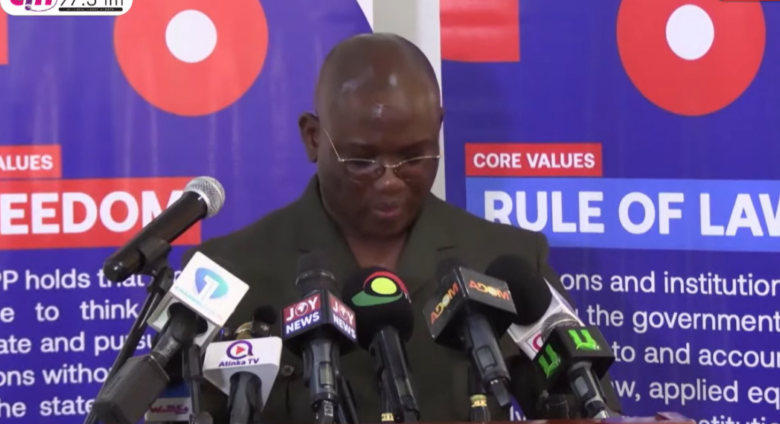
The New Patriotic Party (NPP) has rejected the government’s current approach to reviewing Ghana’s 1992 Constitution and called for the establishment of a Constituent or Consultative Assembly to deliberate on the proposed changes.
The NPP’s position follows the government’s publication of its response to the Constitutional Review Committee’s recommendations in July.
The Constitutional Review Committee submitted its full report to President John Mahama on February 10, 2026. The report contains 147 proposals to amend existing constitutional provisions and 59 entirely new provisions, for a total of 206 proposals.
The NPP says the scale of the proposed changes requires a broader deliberative process before any amendments are taken through the constitutional procedures.
1. The NPP says the Constitution has served Ghana well
The party acknowledges that the 1992 Constitution has provided an important framework for Ghana’s democratic governance.
However, it says some provisions require improvement to strengthen accountability, deepen decentralisation and modernise state institutions.
The NPP says this has been its position for some time, including during the 2010 constitutional review process and in its own Peduase Report.
The NPP points to the 147 proposed amendments to the 299 existing articles, together with 59 new provisions.
It calculates that the amendments affect about 49% of the existing articles.
The party argues that 206 proposals reaching across the Executive, Parliament, the Judiciary, independent constitutional institutions and local government represent a fundamental overhaul rather than a routine amendment exercise.
3. The NPP describes the exercise as effectively a new constitutional settlement
NPP Policy Committee Chairman Kojo Oppong Nkrumah argued that the scale of the proposed changes amounts, in substance, to the enactment of a new constitutional order.
“Amendment 147 of 299 articles, together with 59 new provisions, that is 206 reaching into the executive, the legislature, independent constitutional bodies, and local government is not just an adjustment to some provisions of the constitution; they amount to the overhaul of the constitution and in substance the enactment of a new one,” he said.
4. The party says there are significant disagreements between government and the Review Committee
The NPP says the government has fully accepted 22 of the 147 recommendations and partially accepted another 25.
It therefore argues that about 100 of the Committee’s recommendations remain areas of disagreement between government and the Committee.
This is the party’s characterisation of the government’s response; the government has said it accepted many of the Committee’s recommendations while offering alternative positions on others.
The party says the Committee submitted its full report on February 10, 2026, but the document was not published until July 30.
The government published its position on the same date.
6. The party raises the Tribunals Bill
The NPP also argues that during the period between submission and publication of the Committee’s full report, Parliament passed the Tribunals Bill in a direction it says differed from the Committee’s recommendation.
7. It says consultation has effectively ended
The NPP claims government has declared the consultation process complete and instructed the Constitution Review Implementation Committee to proceed with drafting rather than further negotiation.
It says this leaves no formal platform for political parties, organised labour, professional bodies and other identifiable groups to negotiate areas of disagreement.
Government, however, has said it intends to work through a defined implementation timetable. Attorney-General Dominic Ayine said the two draft amendment Bills were expected to be ready by October 2026.
8. The NPP objects to Parliament being the next major stage
The party argues that government could rely on its parliamentary majority to advance amendments to non-entrenched provisions, while amendments to entrenched provisions would proceed to a referendum.
Government’s stated procedure is that amendments to non-entrenched provisions would be dealt with under Article 291, while entrenched provisions would follow Article 290 and ultimately be submitted to a referendum.
The NPP points to Ghana’s constitutional processes in 1969, 1979 and 1992.
It argues that each involved expert work followed by deliberation through a broader representative body before the resulting constitutional text acquired legal force.
10. The 1969 process
The party cites the Constitutional Commission chaired by Chief Justice Edward Akufo-Addo and the subsequent Constituent Assembly as an example of expert recommendations being subjected to wider deliberation.
11. The 1979 process
The NPP also points to the Constitutional Commission established in 1978 and the Constituent Assembly that subsequently deliberated on the draft constitutional framework.
The party cites the Committee of Experts chaired by Dr S.K.B. Asante and the subsequent Consultative Assembly.
It argues that the Assembly’s draft, rather than the experts’ report alone, became the basis for the 1992 referendum.
13. The NPP says the historical pattern is clear
Its argument is that Ghana’s previous constitutional settlements followed a broad sequence:
Expert body → representative assembly → constitutional settlement
The party says the current process should follow a similar path.
14. It accuses government of skipping the deliberative stage
The NPP says government is moving from the Review Committee’s work to drafting and the formal amendment process without creating a comparable national deliberative body.
It argues that this would leave Parliament and the electorate to consider proposals without an additional structured forum for consensus-building.
15. The party says the disputed issues affect the structure of the state
Among the issues it identifies are:
- The proposed five-year presidential term
- The size and composition of Parliament
- Proposed changes affecting the appointment or election of Members of Parliament
- Whether MPs should be eligible to serve as Ministers
- The method of choosing District Chief Executives
- The independence and funding of constitutional oversight institutions
The NPP argues that these are substantive questions about how Ghana’s political system should operate rather than minor drafting issues.
16. It says there is no mechanism for resolving the disagreements
The party says disagreements are normal in constitutional reform but argues that there must be a structured mechanism for resolving them.
It says no such formal negotiation platform currently exists.
17. The NPP warns against a constitutional settlement without broad political agreement
The party argues that constitutional changes should have sufficiently broad political and societal ownership to ensure stability beyond the government that introduces them.
It says it does not want constitutional arrangements to become subject to repeated changes whenever political power changes hands.
18. The party’s main proposal is a Constituent or Consultative Assembly
The NPP is calling on government to introduce a Constituent or Consultative Assembly Bill in Parliament.
It wants the body to include political parties, organised labour, professional associations, the National House of Chiefs, religious groups, women’s organisations, persons with disabilities, students and youth, the private sector, civil society and representatives from the regions.
19. The NPP says an Assembly could provide a platform for consensus
According to the party, such an Assembly would provide a formal forum for stakeholders to deliberate on the areas where government and the Review Committee differ.
It also says this would respond to calls from various stakeholders for a broader and more structured consultation process.
20. The party says it will oppose the current approach
The NPP says that without a Constituent Assembly or a comparable mechanism for negotiated consensus, it will not support the government’s proposed constitutional amendments.
Mr Oppong Nkrumah said the party’s position amounts to opposing the government’s current implementation approach.
21. The NPP points to the Article 290 referendum threshold
The party also highlights the constitutional requirements for amendments to entrenched provisions.
Article 290 requires at least 40% of persons entitled to vote to participate in the referendum and at least 75% of those voting to approve the proposal.
The government itself has confirmed these thresholds in its position on the review.
22. It says the Constitution belongs to Ghanaians
The NPP argues that the Constitution should not be treated as the property of either the NDC or NPP.
Its position is that constitutional amendments should therefore emerge from a process capable of securing broad national ownership rather than being identified primarily with the party in government.
23. The NPP says it wants the review to succeed
Despite its opposition to the current process, the party says it supports implementing recommendations it considers beneficial to Ghana.
It argues that Ghanaians should ultimately be able to vote on constitutional changes after sufficient deliberation and public engagement.
24. It calls on government to engage stakeholders
The NPP is urging government to listen to organised labour, civil society groups, traditional authorities, professional bodies, students, traders, farmers and other stakeholders, as well as the opposition.
The party says it is offering an alternative process rather than simply seeking to block constitutional reform.
25. The NPP’s bottom line
The party’s central demand is for government to establish a Constituent or Consultative Assembly before proceeding with the proposed constitutional amendments.
Its argument is that the Assembly would provide a formal platform for stakeholders to deliberate on the proposals, resolve areas of disagreement and build broader consensus before the changes are taken through Parliament and, where required, a referendum.
The NPP says it would be willing to participate in such a process but will oppose the current approach if government proceeds without a comparable mechanism for consensus-building.