
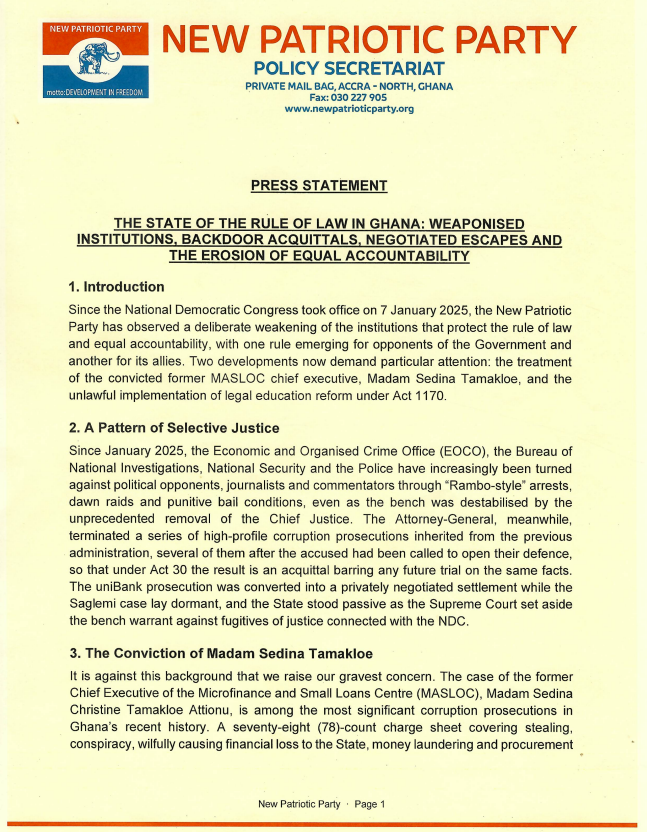
The New Patriotic Party (NPP) has called for the enforcement of the conviction of former MASLOC Chief Executive, Madam Sedina Tamakloe Attionu.
In a press statement issued by Kwame Anyimadu-Antwi, Co-Chair of the party’s Constitutional and Legal Affairs Policy Committee, the NPP accused the National Democratic Congress (NDC) government of undermining the rule of law and equal accountability since assuming office on January 7, 2025.
The party alleged a pattern of selective justice, claiming that state security agencies are being used against political opponents while some corruption-related cases involving pro-government actors are discontinued or settled under favourable terms.
The NPP further raised concern over what it described as politically influenced prosecutions and the discontinuation of several high-profile corruption cases inherited from the previous administration.
Central to its concerns is the case of the former MASLOC Chief Executive, who was convicted on multiple counts including stealing, conspiracy, wilfully causing financial loss to the state, money laundering and procurement breaches.
She was sentenced to 10 years’ imprisonment after a trial conducted in absentia and was recently extradited from the United States to Ghana to serve her sentence.
The NPP said the conviction must remain in force, warning against any attempt to overturn or interfere with the judgment outside the formal appellate process.
It argued that undermining the sentence would set a dangerous precedent for anti-corruption enforcement and weaken public confidence in the justice system.
On legal education reform, the party criticised the implementation of the Legal Education Act, 2026 (Act 1170), particularly the introduction of a mandatory one-year “Pre-Bar Course.”
According to the NPP, the Act does not provide for a Pre-Bar stage and limits the legal training structure to the LLB programme, Law Practice Training and the National Bar Examination.
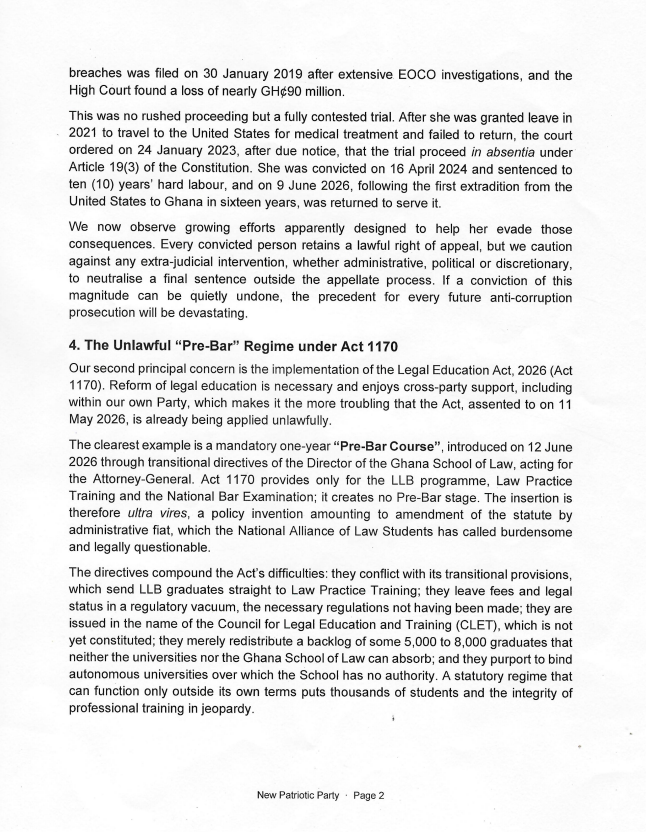
It described the Pre-Bar directive as unlawful, arguing that it was introduced through administrative action without proper statutory backing and in conflict with transitional provisions of the law.
The party also raised concerns over regulatory gaps, institutional authority and the capacity of the Ghana School of Law to manage the implementation process, warning that the current approach risks worsening the backlog of law graduates.
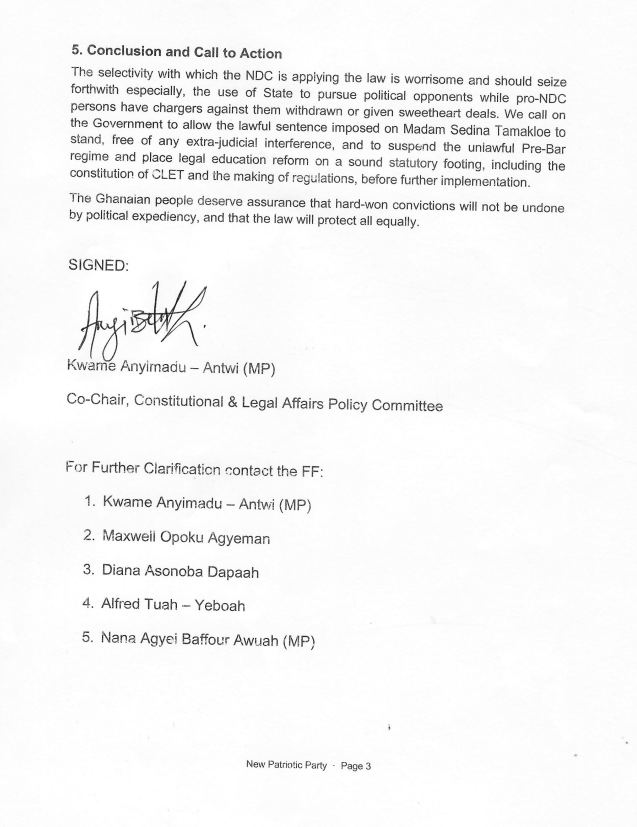
The NPP called for the suspension of the Pre-Bar regime and urged government to ensure that legal education reforms are implemented strictly within the framework of the law, including the constitution of the Council for Legal Education and Training (CLET) and the making of the necessary regulations.
The statement concluded that Ghana’s justice system must remain impartial and free from political interference, stressing that equal application of the law is essential to sustaining public trust in democratic institutions.